
Free shipping over $1,000 How delivery works
Best price guarantee on every sauna How it works
Infrared vs traditional sauna: both heat a room, in different ways. How they compare on heat, steam, wiring, space and price, with real numbers for our saunas.

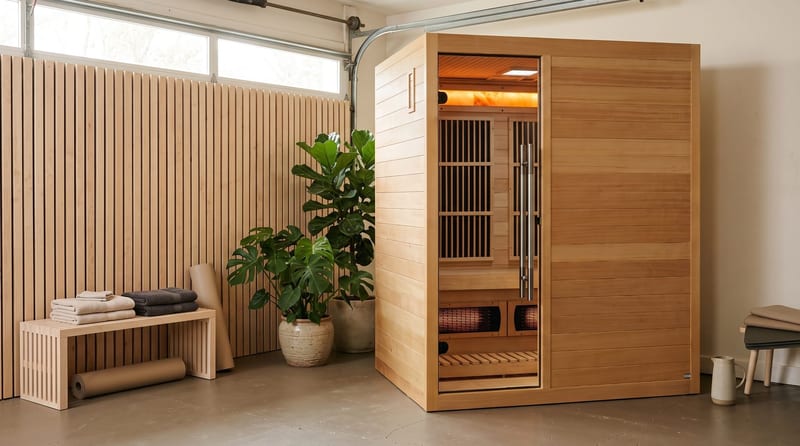
If you are weighing up an infrared vs traditional sauna for a room in your house, the choice usually comes down to four practical questions. How hot do you want it? Do you want steam? What can your electrical panel handle? And how much space and budget do you have?
Below I compare the two on each point, using numbers from the makers’ spec sheets for the saunas we sell.
One honest note before we start. Most of what Hearthwell sells is infrared. We also have thirteen traditional stove saunas, the Sunray Baldwin 2 Person, the Sunray Southport 3 Person, the Sunray Tiburon 4 Person, the Sunray Rockledge 2 Person, the Sunray Galaxie 4 Person, the Golden Designs Hanko 2 Person, the Golden Designs Sundsvall 2 Person, the Golden Designs Copenhagen 3 Person, the Golden Designs Forssa 3 Person, the Golden Designs Kuusamo 6 Person, the Golden Designs Osla 6 Person, the Canadian Timber Element Nook 1-2 Person and the Canadian Timber Element Loft 2-3 Person, and two hybrids with full spectrum infrared and a Harvia traditional stove: the Golden Designs Soria 3 Person Hybrid, with a 6 kW stove, and the Golden Designs Toledo 6 Person Hybrid, with an 8 kW stove. When I talk about traditional saunas in general rather than these fifteen, I will say so.
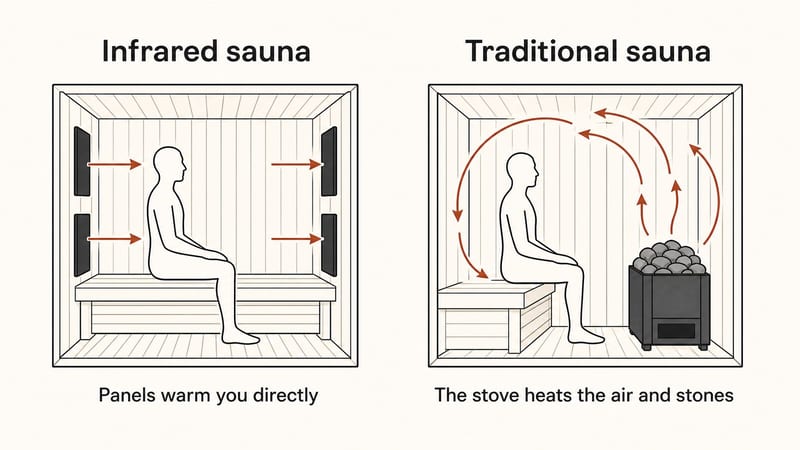
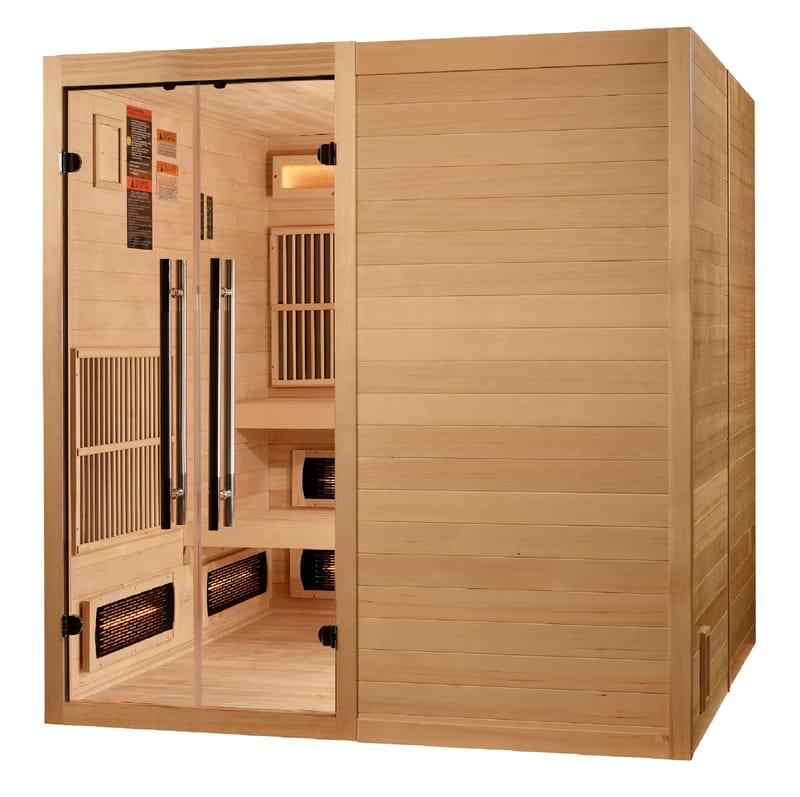
Infrared saunas have heater panels built into the walls. On most of our far infrared models these are carbon panels: six in the compact Dynamic Barcelona, up to fifteen in the 6 person Dynamic Monaco Elite. Full spectrum models add near infrared elements alongside the carbon panels. The panels warm your body directly rather than heating all the air first, which is why the cabin air stays cooler than in a stove sauna.
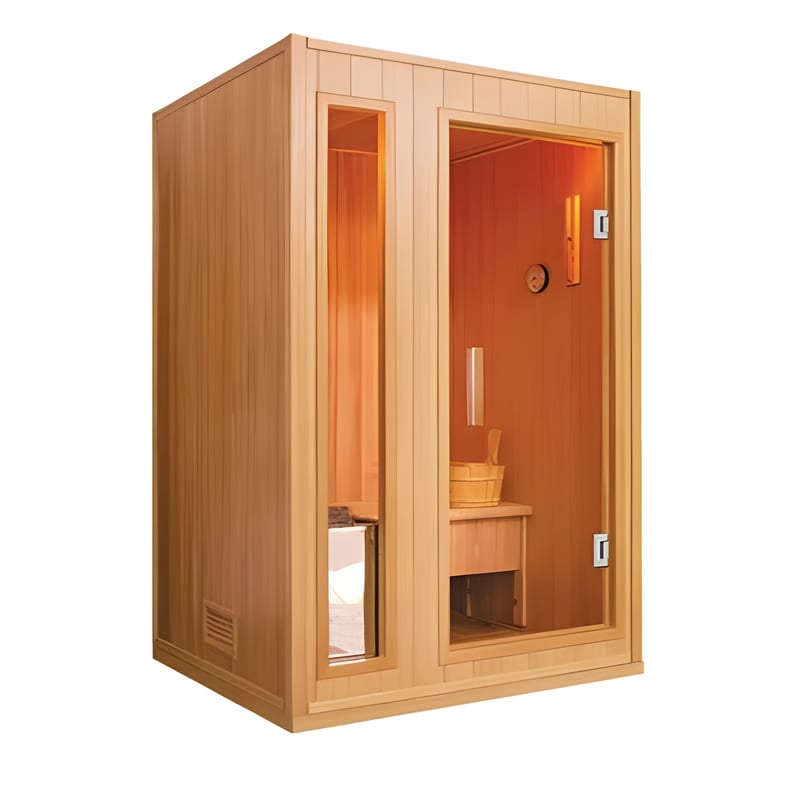
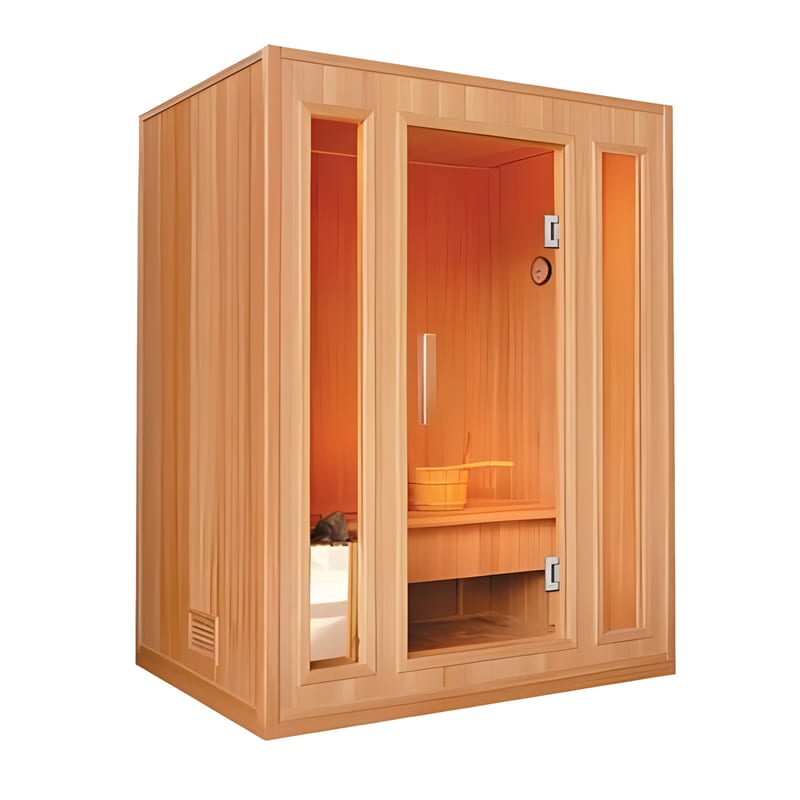
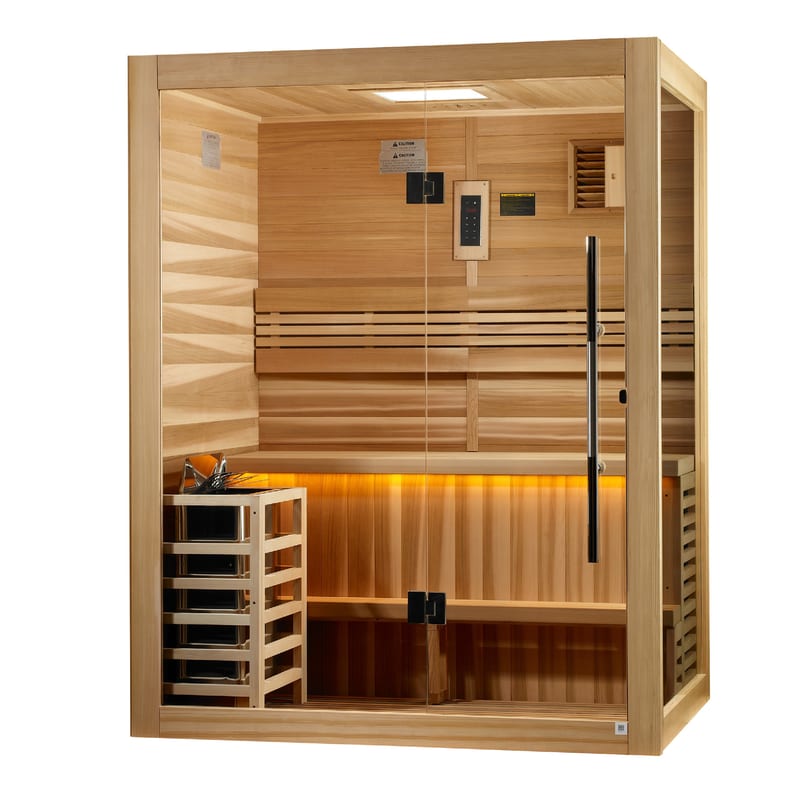
Traditional saunas use a stove, usually electric in a home. The stove heats a basket of stones and the air in the room, and the hot air does the work. The whole room gets hot, from the bench to the ceiling.
For the Dynamic and Golden Designs infrared saunas we sell, the makers state the cabin heats up to 140°F and suggest 118 to 132°F for most sessions. That is the same figure on every one of their models, from the 1 person saunas to the 6 person Monaco. Sunray doesn’t publish a temperature for the cedar Sunray Sedona, so we don’t quote one. GoldenWave rates the HF-MINI, HF-6, HS-2, HF-1, HF-2, HS-4, 51C5 and HF4 up to 149°F (65°C) and the HK5, T-50C3 and T50C up to 140°F (60°C).
Traditional stove saunas run noticeably hotter. On the Hanko, Sundsvall, Copenhagen, Forssa, Kuusamo and Osla, the maker gives 170 to 185°F as the ideal range, and they can reach 190°F. The Sunray Baldwin, Southport and Tiburon heat up to 170°F, and the Sunray Galaxie up to 180°F; Sunray publishes no figure for the Rockledge, and Canadian Timber none for the Element Nook and Loft. Other stoves and rooms vary, so each product page lists the maker’s own figures.
On the Soria and Toledo hybrids, infrared mode heats up to 140°F with 118 to 132°F suggested, and the Harvia stove gives you a traditional, hotter sauna. You run one heat source at a time, not both together.
This is the biggest difference in how the two feel.
In a traditional sauna you can ladle water onto the hot stones. It flashes into steam, the humidity jumps and you feel a wave of heat. For a lot of people that ritual is what a sauna is.
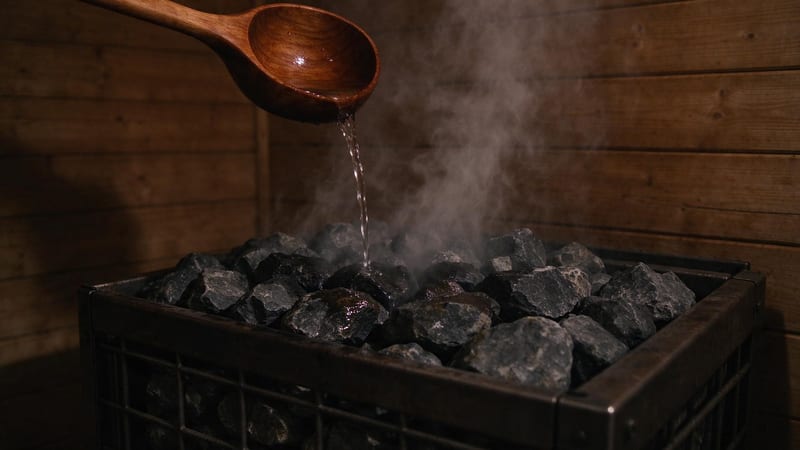
An infrared sauna is dry heat. There are no stones, and you never pour water anywhere near the panels. If you want steam, infrared is the wrong tool.
Steam also means moisture in the room. A traditional sauna needs good ventilation and a room that can handle damp air. Our infrared models are simpler on this front: most list a roof vent, and the Soria and Toledo have roof and side vents. The Hanko and the Forssa each have an adjustable wall vent. If you are thinking about a hybrid mainly for steam, ask us before you order and we will check the maker’s guidance on using water with its stove.
Here infrared has a clear edge for most homes. All 46 of our infrared-only saunas run on 120V:
The fifteen saunas with a stove need more:
Electric stoves for home saunas generally need 240V and are wired in by an electrician, so plan on that cost with any traditional sauna. For their infrared and hybrid models, Dynamic and Golden Designs say no GFCI outlet and no extension cords, which is good practice for any plug-in sauna.
Our infrared saunas are prefab cabins that stand on a flat, level, hard floor. The smallest, the GoldenWave HF-MINI, is 28.3" wide, 32.3" deep and 61.4" tall; most compact models are about 39" wide by 35 to 36" deep, and heights run up to 80", so they fit a spare-room corner or a basement with a normal ceiling. On the Dynamic models the wall panels clasp together; plan on two people for assembly.
A traditional sauna needs room for the stove and its safety clearances, a way to deal with steam, and the 240V wiring. That usually means a bigger, more planned space. The Baldwin and the cedar Rockledge are the compact options at 59" wide, 42" deep and 75" tall, the Southport seats three in 69" wide, 47" deep and 75" tall, the Tiburon seats four in 63" wide, 69" deep and 79" tall, the Galaxie seats four in 71" wide, 55" deep and 79" tall, the Hanko is 64" wide, 48" deep and 78" tall, the Sundsvall is 60" wide, 46" deep and 83" tall, the Copenhagen seats three in 79" wide, 59" deep and 83" tall, and the Forssa seats three in 75" wide, 48" deep and 78" tall. The Kuusamo seats six in 77" wide, 67" deep and 82" tall, and the Osla seats six in 79" wide, 72" deep and 83" tall. The Canadian Timber Element Nook seats one or two in 54.75" wide, 54.75" deep and 88" tall, and the Element Loft two or three in 74.75" wide, 54.75" deep and 88" tall; at 88" they are our tallest cabins. The Hanko, Sundsvall, Copenhagen, Forssa, Kuusamo and Osla want a water-tolerant floor such as concrete or tile, and the Sunray models a dry, level indoor spot away from showers, as do the Element saunas. The Soria hybrid is 65" wide, 57" deep and 80" tall, and the Toledo hybrid 80" wide, 83" deep and 80" tall, our biggest footprint. My indoor sauna install guide walks through measuring the room, the delivery path and the wiring step by step.
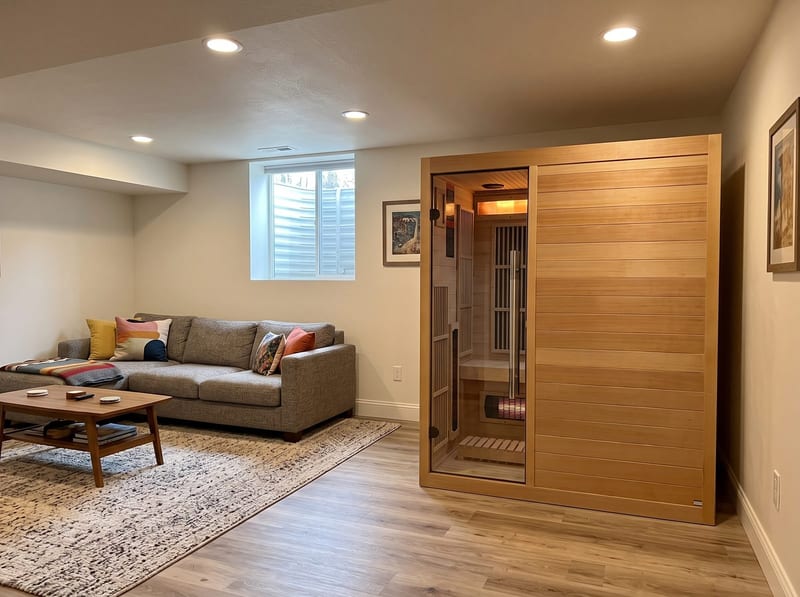
Here is how our range lines up on price:
Every one of these ships free, since they are all over our $1,000 free shipping threshold, and if you find the same sauna for less at another authorized US retailer, we’ll match the price. Add an electrician’s bill if your model needs a new circuit, and always if it needs 240V.
For running costs, compare the power draw. The Barcelona draws 1,600 watts, so an hour at full power uses 1.6 kWh. The Harvia stove in the Hanko, the Sundsvall, the Tiburon, the Galaxie and the Soria, and the Element Loft’s heater option, are rated at 6 kW, so an hour at full power uses 6 kWh. At about 18 cents per kWh, close to the 2026 US average home electricity price the EIA forecasts, that is roughly 29 cents an hour for the Barcelona and about $1.08 an hour for the 6 kW stove. The 3.5 kW heater in the Baldwin works out at about 63 cents an hour, the 4.5 kW heater in the Southport, the Rockledge and the Element Nook’s heater option at about 81 cents, and the 8 kW stove in the Forssa, Copenhagen, Kuusamo, Osla and Toledo at about $1.44 an hour. Stoves and panels cycle on and off once the room is up to temperature, so your real use will be lower than the rating, but the gap between the two gives you a fair idea. Your own rate is on your bill, and my home sauna cost guide shows the math for more models.
| Infrared (our range) | Traditional stove sauna (in general) | |
|---|---|---|
| How it heats | Wall panels warm you directly | Stove heats the air and stones |
| Air temperature | Up to 140°F on most models (GoldenWave HF-MINI, HF-6, HF4, HS-2, HF-1, HF-2, HS-4 and 51C5: 149°F); 118 to 132°F suggested by Dynamic and Golden Designs | Noticeably hotter; 170 to 185°F is the ideal range on the Hanko, Sundsvall, Copenhagen, Forssa, Kuusamo and Osla, the Baldwin, Southport and Tiburon reach 170°F and the Galaxie 180°F |
| Steam | None; dry heat | Water on the stones for steam |
| Power | 120V on all 46 of our infrared-only models; 32 plug into a standard outlet | Usually 240V, wired by an electrician |
| Install | Panels assemble on a level, hard floor | Stove clearances, ventilation, 240V wiring |
| Floor | Flat, level, hard floor | A dry, level floor; the Golden Designs stove saunas want a water-tolerant one such as concrete or tile |
| Running cost at full power (18¢/kWh) | About 25 to 50 cents an hour on most of our models (1,400 to 2,700 W) | About 63 cents an hour for the 3.5 kW Baldwin, 81 cents for the 4.5 kW Southport and Rockledge, $1.08 for a 6 kW stove, $1.44 for 8 kW |
| Smallest size we sell | 28.3" W x 32.3" D x 61.4" H (the GoldenWave HF-MINI) | The Baldwin and Rockledge: 59" W x 42" D x 75" H |
| Price at Hearthwell | Includes our lowest-priced saunas | The Baldwin, Southport, Tiburon, Rockledge, Galaxie, Hanko, Sundsvall, Copenhagen, Forssa, Kuusamo, Osla, Element Nook and Element Loft (with its heater, our highest-priced sauna), and the Soria and Toledo hybrids |
For most homes, I would start with infrared. It plugs into the wiring you probably already have, it fits a small room, and it costs less to buy and run. A good place to look is the infrared saunas collection, or the low EMF infrared saunas if keeping EMF down matters to you. For two people, the San Marino plugs into a 120V/15A outlet. If you want near infrared elements too, the Dynamic Santiago 2 Person Full Spectrum runs on the same kind of plug, and the full spectrum collection has the rest.
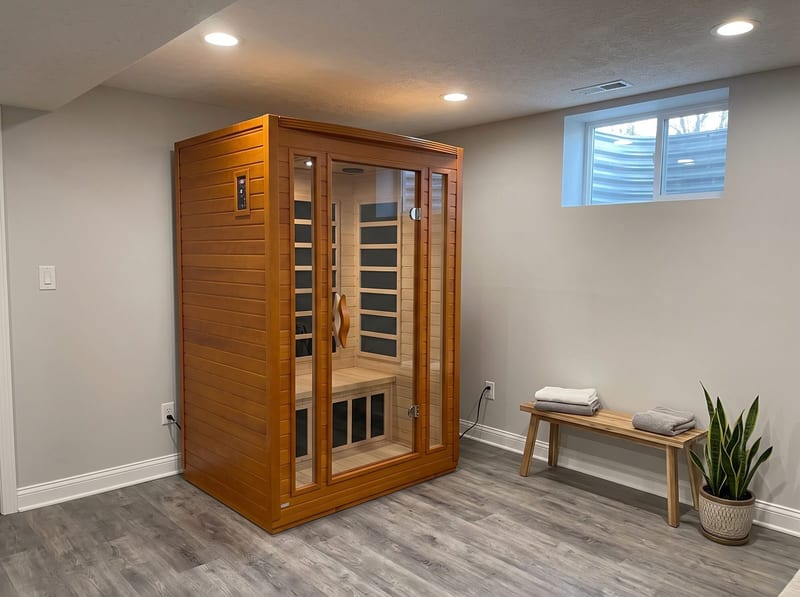
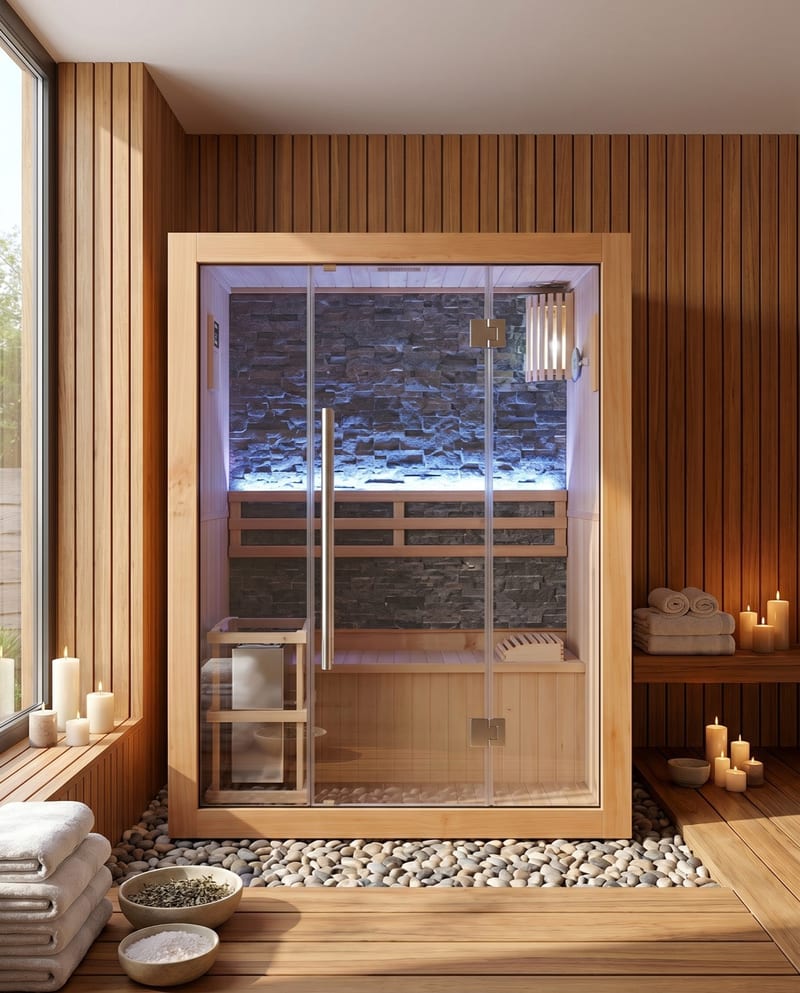
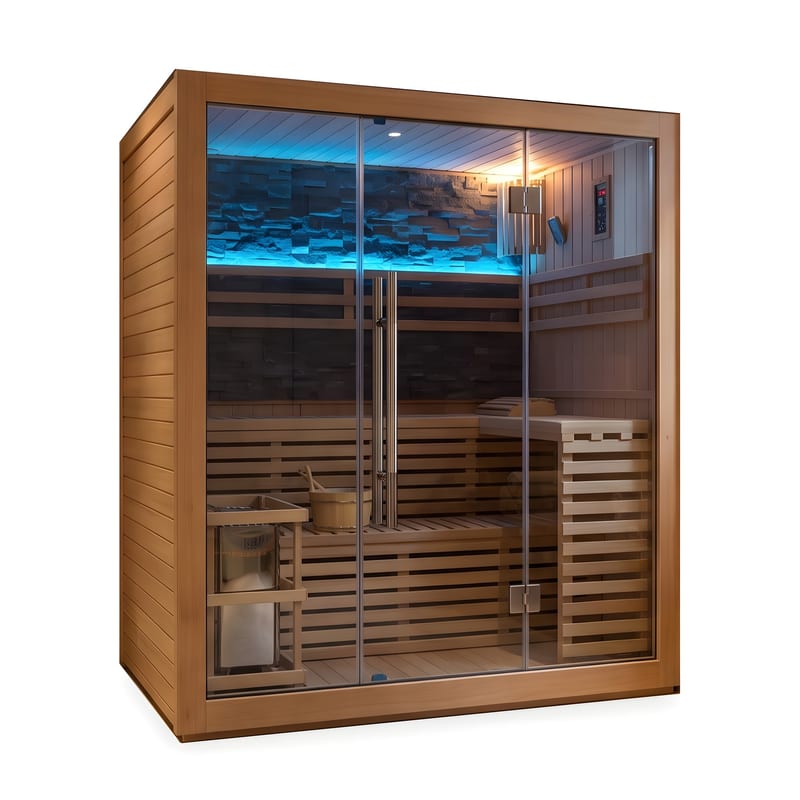
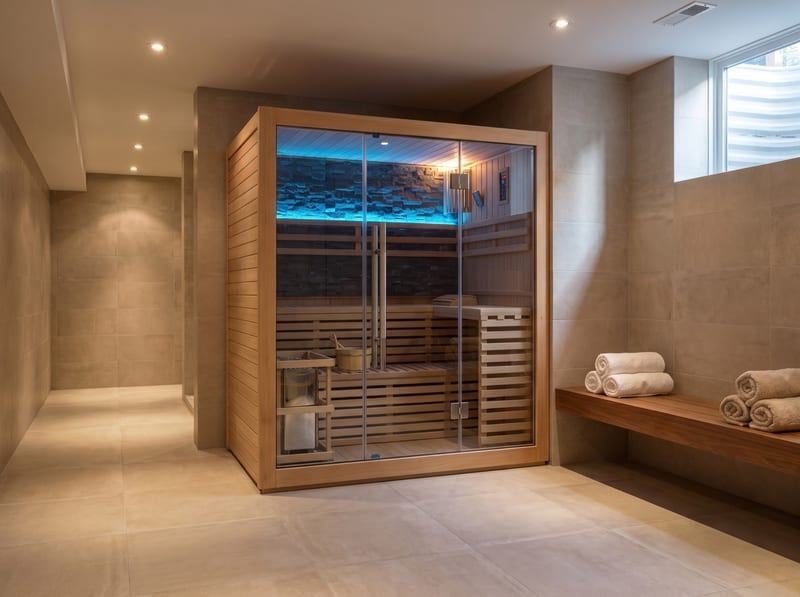
If steam on hot stones is what you are after, infrared will disappoint you. The Baldwin, the Rockledge, the Hanko and the Sundsvall are our stove saunas for two, the Element Nook seats one or two and the Element Loft two or three (both in Thermo Grandis behind a full glass front), the Southport, the Forssa and the Copenhagen seat three (the Forssa and the Copenhagen with a bigger 8 kW stove, the Copenhagen in cedar inside and out behind an all-glass front), the Tiburon and the Galaxie seat four with a 6 kW heater (the Galaxie adds a stone wall, color lights and Bluetooth), the Kuusamo and the Osla seat six with the same 8 kW stove as the Forssa (the Osla in a bigger cabin, cedar inside and out), and the Soria adds infrared to the Hanko’s size of stove if you want both, and the Toledo does the same for six with an 8 kW stove; each needs a 240V circuit. Our traditional saunas page lines them up side by side. Either way, send me your room size and your panel details and I will help you work out what fits.
A traditional stove sauna runs hotter. Our Dynamic and Golden Designs infrared saunas heat up to 140°F, and the makers suggest 118 to 132°F for most sessions. On our Hanko, Sundsvall, Copenhagen, Forssa, Kuusamo and Osla stove saunas the ideal range is 170 to 185°F, the Baldwin, Southport and Tiburon heat up to 170°F, and the Galaxie up to 180°F. Infrared feels comfortable at lower air temperatures because the panels warm you directly instead of heating all the air.
No. An infrared sauna is dry heat with no stones, and water should never go near the heater panels. If you want steam, you need a traditional stove sauna.
Not always. 32 of our 46 infrared-only saunas plug into a standard 120V outlet (a dedicated outlet is recommended). Twelve need a dedicated 120V circuit (20A; Sunray gives no amp rating for the Savannah and GoldenWave none for the HS-2, so plan 20A) and two need two circuits, so those call for a licensed electrician. None of the infrared models should go on a GFCI outlet or an extension cord. Every stove sauna we sell, including the hybrids and the Element saunas with their heater option, needs a 240V circuit wired by an electrician.
Yes, two of ours do. The Golden Designs Soria 3 Person Hybrid has full spectrum infrared (five carbon panels and three near infrared elements) and a Harvia 6 kW stove on a 240V/30A circuit. The Toledo 6 Person Hybrid has five carbon panels, eight near infrared elements and a Harvia 8 kW stove on one 240V/40A circuit. You run one heat source at a time, and a licensed electrician wires the circuit.
Usually infrared. At about 18 cents per kWh (the EIA’s 2026 US average forecast), an hour at full power costs roughly 14 to 30 cents on our compact infrared models (800 to 1,700 W) and about $1.08 for the 6 kW Harvia stove ($1.44 for the 8 kW stove in the Forssa, Copenhagen, Kuusamo, Osla and Toledo). Both cycle once the room is hot, so real use is lower.
Yes, thirteen so far. Sunray’s Baldwin 2 Person, Southport 3 Person and Tiburon 4 Person have Harvia heaters (3.5, 4.5 and 6 kW) in Canadian hemlock; the Rockledge 2 Person and Galaxie 4 Person (4.5 and 6 kW) are cedar with a stone back wall. Golden Designs’ Hanko and Sundsvall (6 kW) and Forssa, Copenhagen, Kuusamo and Osla (8 kW) have red cedar inside. Canadian Timber’s Element Nook 1-2 Person and Loft 2-3 Person are Thermo Grandis with a glass front, as a cabin or with a 4.5 or 6 kW Harvia heater. The Soria and Toledo are hybrids.
Ethan Parker
Sauna Specialist
Ethan Parker is a home wellness expert with over a decade of experience in the consumer products industry. He founded the store with a simple mission: to make buying an indoor sauna transparent, straightforward, and stress-free. Whether he's breaking down the science of infrared heat or testing new models, Ethan provides honest, jargon-free advice to help families find their perfect fit. Outside of work, he is passionate about fitness, hiking, and building healthy, relaxing routines with his family.
Help me choose
Five quick questions about your room, your power and your budget. We'll show the saunas that fit best.
Shop the story
 New
 New
 New
 New
 New
 New
 New
Free shipping over $1,000
Saunas arrive by curbside freight, and the carrier calls ahead.
How delivery works